
Blog
Wind and the Wide Garage Door in Fullerton
Fullerton's 1960s-70s housing stock and mild temperate climate mean wind load on wide double doors is a year-round structural issue, not a seasonal one.
Season by Season
Fullerton doesn't get the freeze-thaw cycle that cracks concrete and seizes hardware in colder towns. The climate band here is mild temperate, which means no deep winter, no ice on the track, no snow load to plan for. That sounds like good news for a garage door, and in some ways it is.
But it also means there's no off-season where wind stress lets up. In a place with a hard winter, homeowners brace for a few bad months and relax the rest of the year. Here, a wide double door is under some amount of wind pressure most weeks, just at varying intensity. There's no season where the door gets a break the way the rest of the house structure might.
That matters more for older doors than new ones. Houses in this area were built mostly between 1938 and 2012, with the median landing around 1964, and a door installed or replaced on that timeline often wasn't engineered with sustained wind load in mind the way current products are. The door itself doesn't know what season it is. It just reacts to pressure, every time the wind pushes on a flat surface roughly sixteen feet wide.
What Is Going On
A single door, roughly nine feet wide, flexes a little under wind and the track usually absorbs it fine. A double door at sixteen feet is a different animal. Wind doesn't need to be dramatic to matter here - it just needs a wide, flat surface to push against, and a double door gives it one.
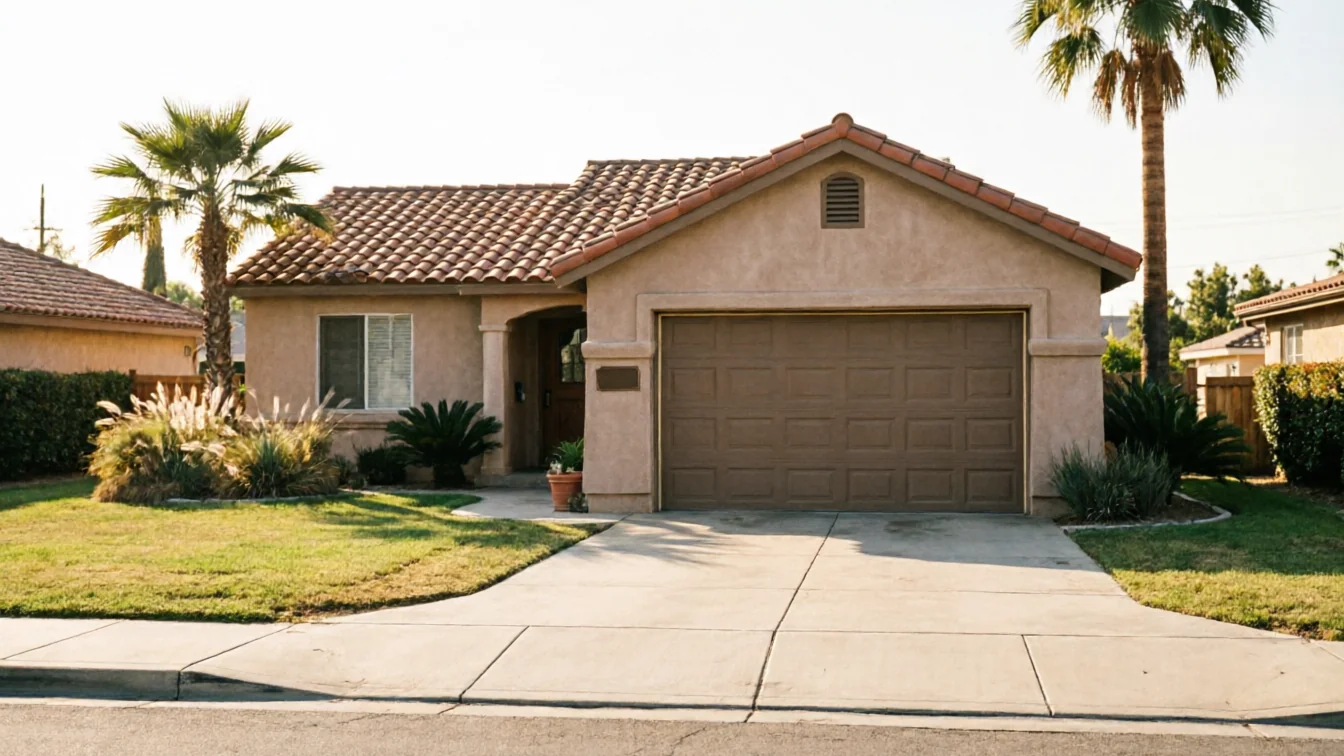
The 1960s and 70s building wave that makes up most of this area's housing stock left a lot of two-car garages running factory track and hardware sized for a lighter era of construction. These doors often don't have the horizontal reinforcement that wider openings get in current builds. When wind pushes on a panel without that bracing, the stress goes somewhere - usually into the track brackets at the top corners, or into the center where two panels meet.
What you see from inside the garage is subtle at first: a track pulling slightly away from the wall, a top panel that looks like it's bowing outward when the door's down, hinges that have started to work loose at the same two or three spots every time. None of that fixes itself. It gets worse under the next push.
When to Call Someone
Call if a track bracket has visibly pulled away from the framing, even by a quarter inch - that's not cosmetic, that's the anchor point losing its grip. Call if a panel on a wide door looks bowed or wavy when it's fully down and the wind isn't even blowing. Call if the door rattles or shudders in a way it didn't a year ago; that's usually loosened hardware, not a new problem showing up out of nowhere.
Here's the honest limit: once a track has bent past a certain point, straightening it back into true usually doesn't hold. We can true up a track that's barely off, but a track that's been pulled and released repeatedly develops a memory for the bent shape, and it'll walk back out of alignment within months. At that point replacing the track - sometimes the whole door - is the straightforward call, not a patch job that fails again.
If you're not sure whether what you're looking at is minor wear or a structural problem starting, that's exactly the kind of thing worth a look before it becomes an emergency call on a Saturday.
What the Weather Here Does to It
Across the 76 named communities built out in that same mid-century wave, the pattern repeats: a lot of original two-car doors, running original or near-original hardware, on houses built with a median year around 1964. None of those doors were engineered against sustained wind pressure the way a current code-compliant wide door is, because wind load wasn't the design priority for a mild climate like this one - heat and sun exposure were.
That's the quiet problem. A door built for this climate's dryness and sun doesn't automatically hold up to repeated wind flex, because those are two different engineering questions. Wide doors in particular - the double-car size that's common across owner-occupied houses here - take more of that pressure per square foot of panel than a single door does.
With a median household income of $96,041 across the service area, replacement with a properly reinforced door is often the practical call once a wide door's track or panel has gone out of true, rather than repeated patch repairs on hardware that was never built for the load it's carrying now.
Questions
Common questions
Why does my double door shake more than my neighbor's single door?
Width is the main reason. A double door spans roughly sixteen feet of panel versus about nine for a single, so wind pressure has more surface to push against. If the door was built without a center reinforcing strut - common in homes from the 1960s and 70s building wave here - that flex shows up as rattling or visible bowing.
Is this a seasonal problem in Fullerton?
Not really. The mild temperate climate here doesn't give a hard winter where wind stress concentrates into a few months. The pressure is lower-grade but more constant year-round, which means the wear on track brackets and hinges builds up steadily rather than in a predictable seasonal spike.
Can a bent track just be bent back straight?
Sometimes, if it's barely off. But a track that's been pushed out of true repeatedly tends to develop a memory for that bent shape and drifts back out of alignment within months of being straightened. Past a certain point, replacing the track section is the repair that actually holds.
Do newer doors have this problem too?
Less often. Doors built to current code typically include horizontal reinforcement on wider openings specifically to handle wind load, which a lot of original doors from this area's 1960s-70s housing stock don't have. Age of the door matters more than age of the house itself.
Recommendation
You Might Also Like
More garage door guides for Fullerton homeowners.
Noises That Mean Something
A guide for Fullerton homeowners on the clunks, squeals, and grinds that matter, tied to the 1960s-70s housing stock and mild climate common across the area.
Read guide
What a Technician Checks First on a Fullerton Garage Door
A Fullerton technician's first stops on a service call, tied to this city's 1960s-70s housing stock and mild coastal-inland climate swings.
Read guide
Fullerton Garage Doors: Repair or Replace
A Fullerton homeowner's guide to knowing when a garage door repair stops making sense, based on this area's 1960s housing stock and mild coastal climate.
Read guideReady when you are
Need a garage door sorted in Fullerton?
Fullerton Garage Door Pros repairs and installs garage doors, springs and openers in Fullerton, CA and the surrounding area.